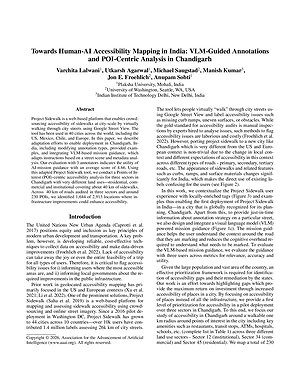
Towards Human-AI Accessibility Mapping in India: VLM-Guided Annotations and POI-Centric Analysis in Chandigarh
Workshop Proceedings of AI4UP 2026
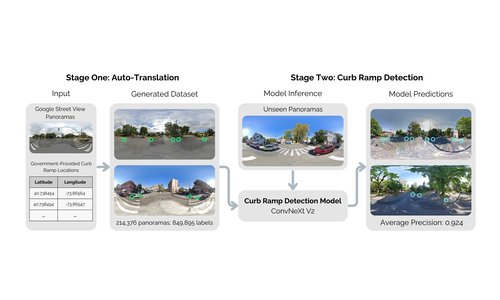
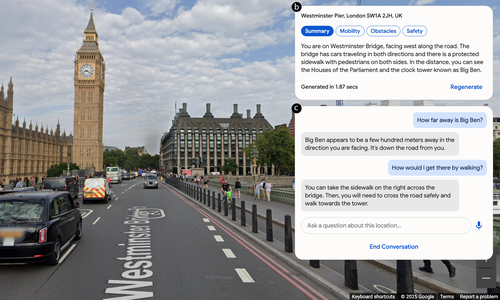
This project describes a two-pronged vision: first, to develop scalable data collection methods for acquiring sidewalk accessibility information using a combination of crowdsourcing, computer vision, and online map imagery, and second, to use this new data to design, develop, and evaluate a novel set of navigation and map tools for accessibility. Our overarching goal is to transform the ways in which accessibility information is collected and visualized for every sidewalk, street, and building façade in America.
 Jon E. Froehlich · PI
 Yochai Eisenberg · Co-PI
 Mikey Saugstad · Lead


Workshop Proceedings of AI4UP 2026
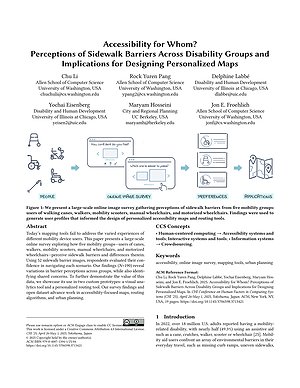
Proceedings of CHI 2025 | Acceptance Rate: 24.9% (1249 / 5020)
PDF arXiv doi Cite Code Project Sidewalk Accessibility for Whom?
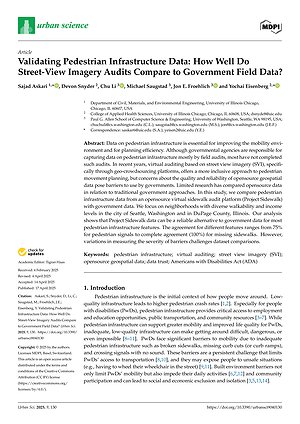
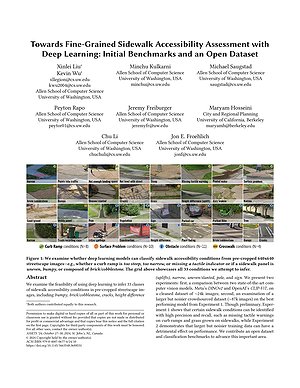
Poster Proceedings of ASSETS 2024 | Acceptance Rate: 66.7% (58 / 87)
PDF doi Cite Deep Learning for Sidewalk Assessment Project Sidewalk
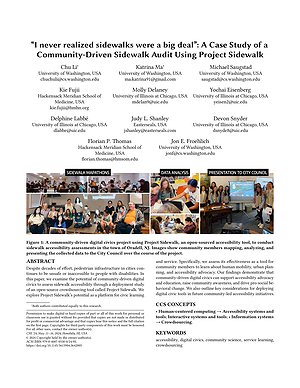
Proceedings of CHI 2024 | Acceptance Rate: 26.3% (1060 / 4028)
PDF doi Cite Project Sidewalk + Community Science Project Sidewalk
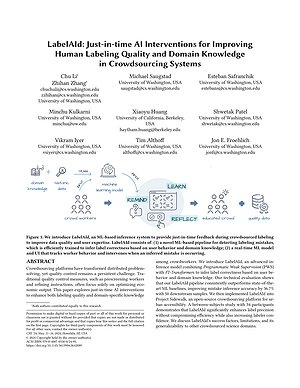
Proceedings of CHI 2024 | Acceptance Rate: 26.3% (1060 / 4028)
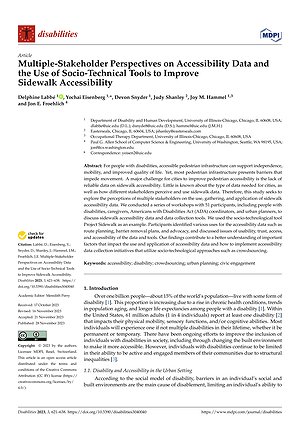
Demo Proceedings of ASCIP 2023 Annual Meeting 2023
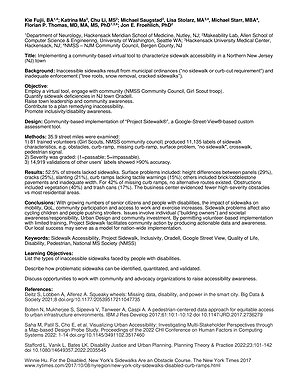
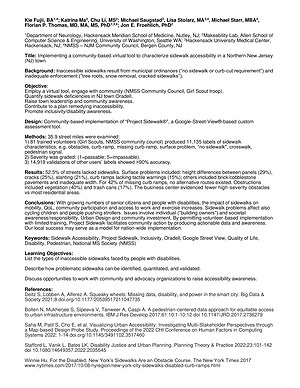
Poster Proceedings of CMSC 2023 Annual Meeting 2023
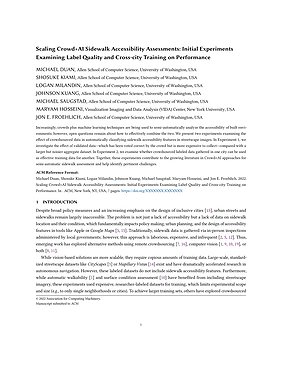
Proceedings of ASSETS'22 2022 | Acceptance Rate: 58.9% (43 / 73)
PDF doi Cite Project Sidewalk Deep Learning for Sidewalk Assessment
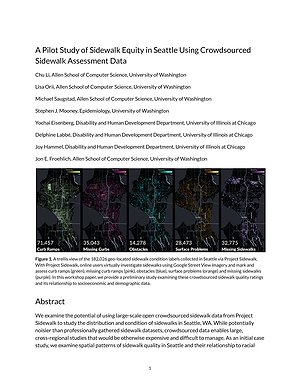
Workshop Proceedings of UrbanAccess 2022
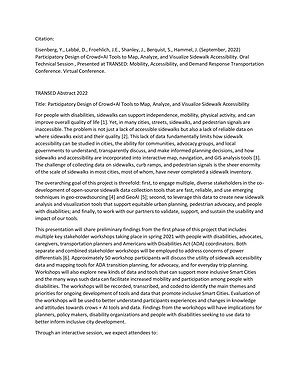
Extended Abstract Proceedings of TRANSED 2022

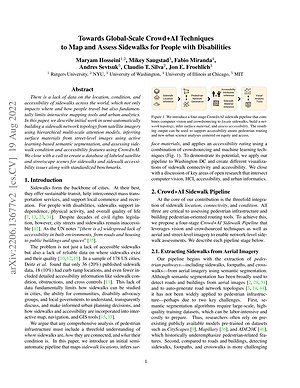
Workshop Proceedings of CVPR2022 Workshop: Accessibility, Vision, and Autonomy (AVA) 2022
PDF arXiv doi Cite Project Sidewalk Deep Learning for Sidewalk Assessment

Proceedings of CHI 2022 | Acceptance Rate: 24.7% (637 / 2579)
PDF doi Cite Talk Project Sidewalk AccessVis Accessibility-Infused Maps Multi-Stakeholder Interviews to Examine Urban Accessibility
Demo Proceedings of ASSETS 2021
|
Acceptance Rate: 61.8% (55 / 89)
|
 Best Artifact Runner-up Award
Demo Proceedings of ASSETS 2021 | Acceptance Rate: 61.8% (55 / 89)


Workshop Proceedings of Civic Tech 2020
Workshop Proceedings of Data4Good 2020
Proceedings of ASSETS 2019
|
Acceptance Rate: 25.9% (41 / 158)
|
 Best Paper Award
PDF doi Cite Code Project Sidewalk Deep Learning for Sidewalk Assessment
Proceedings of CHI 2019
|
Acceptance Rate: 23.8% (705 / 2960)
|
Best Paper Award
Interactions 2019

Extended Abstract Proceedings of CHI 2018
Poster Proceedings of ASSETS 2017
UMD CS PhD Dissertation 2016
UMD CS MS Thesis 2016
Proceedings of CHI 2016 | Acceptance Rate: 25.0% (600 / 2400)
PDF doi Cite Accessibility-Infused Maps Project Sidewalk Multi-Stakeholder Interviews to Examine Urban Accessibility

Doctoral Consortium Proceedings of UIST 2014
Poster Proceedings of HCOMP 2013
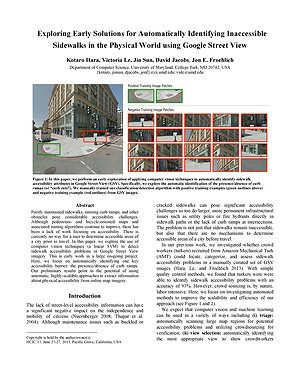
Workshop Proceedings of HCIC2013 Workshop 2013
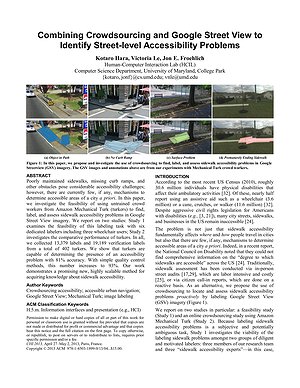

Poster Proceedings of ASSETS 2012
Feb 29, 2024 | NSF Smart and Connected Communities Panel on “Pathways to Transitioning Project Outcomes"
Nashville, Tennessee
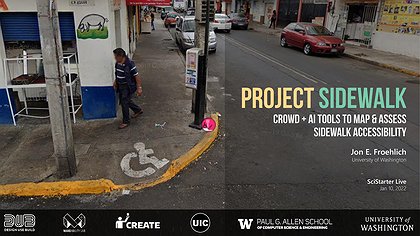

Dec 14, 2022 | ITS (Intelligent Transportation Systems)
Tacoma, Washington
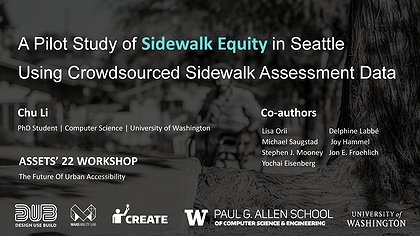
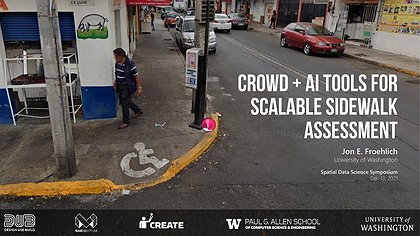
Dec 13, 2021 | Spatial Data Science Symposium
Virtual

May 28, 2021 | PhD Generals Exam
Virtual
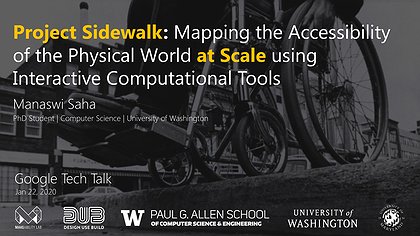
Jan 22, 2020 | Google Tech Talk
Seattle, WA
Sep 30, 2019 | WSRO 2019 Keynote
Spokane, WA
May 07, 2019 | CHI'19
Glasgow, UK
Oct 09, 2018 | Change Seminar
University of Washington, Seattle
Nov 15, 2017 | UW CSE Affiliates
Seattle, WA
May 25, 2017 | HCIL Symposium
College Park, Maryland



Apr 06, 2017 | Lecture Series at the Laboratory for Telecommunication Sciences
LTS Auditorium, College Park, MD
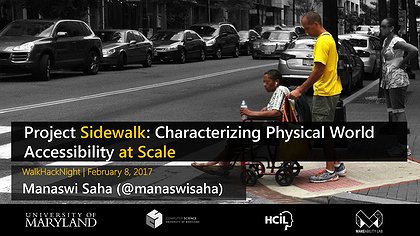
Feb 08, 2017 | WalkHackNight II
Arlington, Virginia
Nov 07, 2016 | Diversity in Computing Summit
College Park, Maryland
Meethu Malu, Uran Oh, Ladan Najafizadeh, Manaswi Saha, Lee Stearns
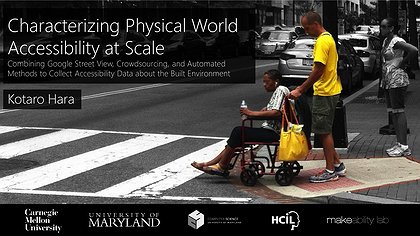
Nov 03, 2016 | GroupSight @ HCOMP
Austin, Texas

Nov 03, 2016 | Technica: Tech+X Talk Series
University of Maryland, College Park
Liang He, Majeed Kazemitabaar, Manaswi Saha, Soheil Behnezhad
![Illustration of a multi-story indoor house layout used in the CapNav benchmark. The diagram asks: “Can [AGENT] go from the basement foyer to the top floor rest area?” The basement foyer (START) is at the bottom left, and the top floor rest area (END) is at the top right. Colored paths show different possible routes through labeled areas including Garage, First Floor Hallway, and Elevator. Icons on the left represent four agent types: a wheelchair user (allowed, green check), a quadruped robot (allowed, green check), a human (allowed, green check), and a sweeping robot (not allowed, red X). Red X markers and warning labels indicate constraints such as “Cannot go up stairs” and “Cannot operate elevator,” showing how different mobility capabilities affect route feasibility.](/media/projects/images/CapNav-Thumbnail.png.500x300_q85_box-135%2C10%2C2826%2C1627_crop_upscale.png)