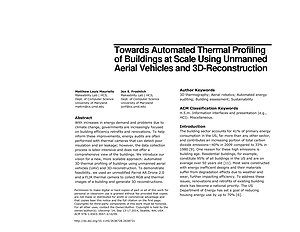
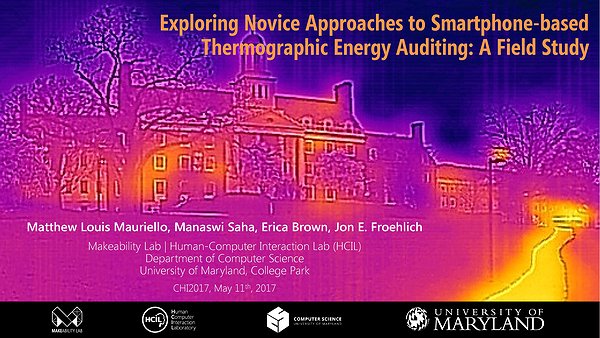
Improving energy efficiency in the built environment is an important global concern. In the United States, for example, buildings account for 41% of primary energy consumption–more than any other sector–and contribute an increasing portion of carbon dioxide emissions (33% in 1980 vs. 40% in 2009). To reduce consumption and emission levels, the U.S. Department of Energy (DOE) recommends energy audits to help identify sources of inefficiencies and reduce consumption (e.g., home energy audits typically identify improvements that lead to 5-30% reductions in utility use). Moreover, energy audits are increasingly becoming part of building efficiency certification programs. In response, interest in energy auditing has increased.
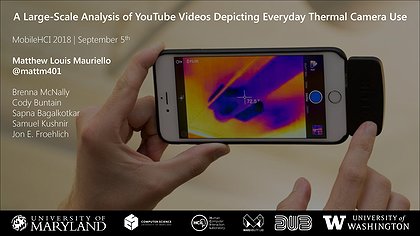
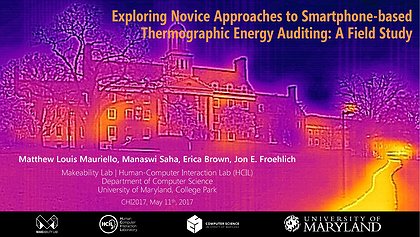
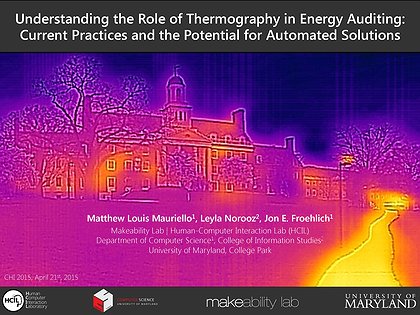
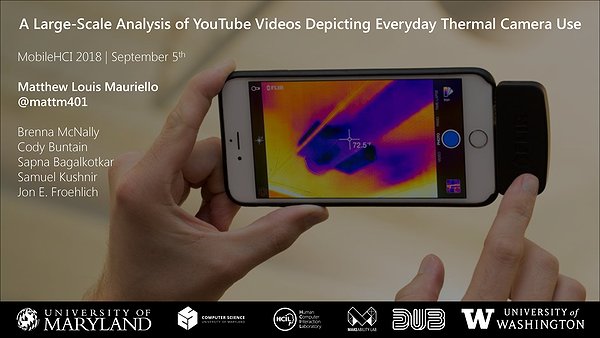
Our work focuses on thermography, a data collection and visual analytics technique utilizing thermal cameras, which energy auditors use to identify, diagnose, and document efficiency issues (e.g., missing insulation, air leakage) in buildings. The use of thermography during an energy audit helps the auditor find and communicate problems to building owners and including thermal imagery in inspection reports has been shown to lead to two primary outcomes: (i) an increased likelihood that the building owners will make retrofit decisions and (ii) an increased likelihood that building occupants will engage in conservation behaviors. With respect to increasing the overall energy efficiency of the built environment, both outcomes are desirable.
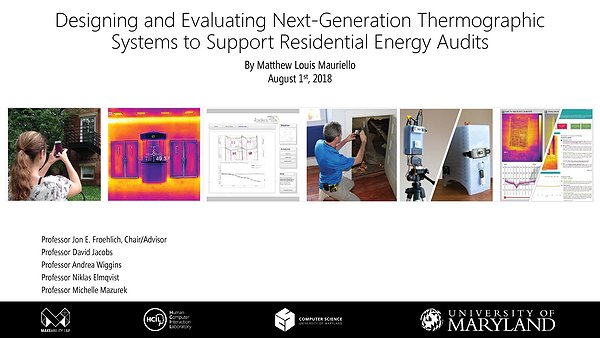
Our work investigates scaling thermographic inspections along two dimensions: first, scaling in terms of who can perform thermographic audits by building and evaluating computer assisted
thermographic tools to help with both capture and analysis; second, scaling in terms of time by
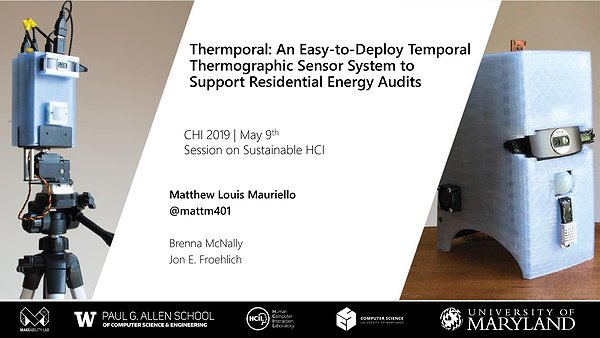
building and evaluating new indoor, automated temporal data collection and analysis tools. Related to this, we explore three key areas: (i) current thermographic energy auditing practices, (ii) the application of machine learning, image processing, and information visualization techniques to classify and gather insights from real world thermographic data, and (iii) developing new methods and tools to support human-oriented thermographic data collection and analysis activities.
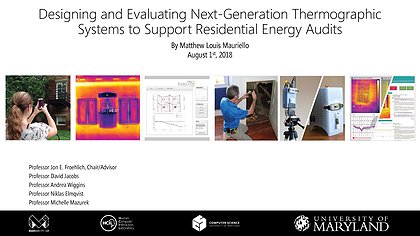
Aug 01, 2018 | PhD Defense, Computer Science
University of Maryland, College Park
Matthew L Mauriello
Apr 06, 2017 | Lecture Series at the Laboratory for Telecommunication Sciences
LTS Auditorium, College Park, MD
Jon E. Froehlich

 Honorable Mention