Rebuilt StreetReaderAI Is Now Open Source

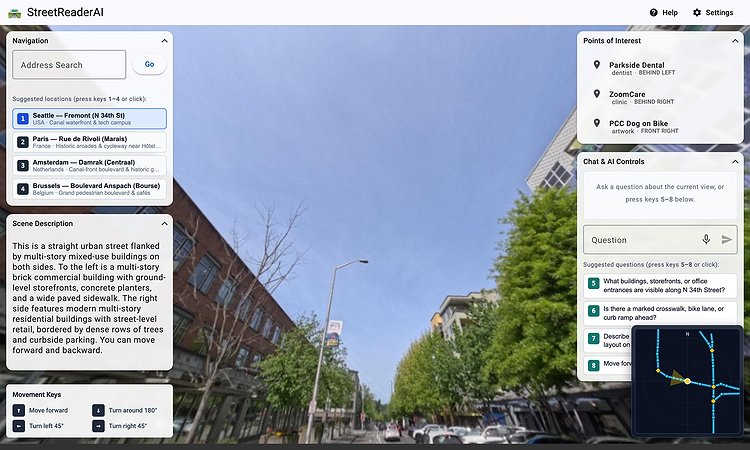
We're excited to share that a version of StreetReaderAI, our accessible street-view prototype for blind and low-vision travelers, is now open source! The code is on GitHub at github.com/research-ground/streetreaderAI under the Apache 2.0 license.
StreetReaderAI lets blind and low-vision users virtually walk through real streets, step by step along street blocks and across intersections, using keyboard shortcuts or voice. At each step it gives concise, accessibility-focused scene descriptions, announces intersecting streets and nearby points of interest relative to the user's position, and answers natural-language questions about the current view, like "Is there a marked crosswalk or curb ramp ahead?"
The open-source version runs on open data by default: Panoramax and Mapillary for 360° street imagery, OpenStreetMap for routing and points of interest, and Google Gemini or OpenAI for AI descriptions and Q&A. You can import it into Google AI Studio and run it on the free tier with no setup, or run it locally with Node.js.
The open-source release was created by Shaun Kane, Sam Sepah, Bill Neubauer, and Philip Nelson at Google, based on our UIST 2025 paper, "StreetReaderAI: Making Street View Accessible Using Context-Aware Multimodal AI" by Jon E. Froehlich, Alexander J. Fiannaca, Nimer M. Jaber, Victor Tsaran, and Shaun K. Kane. It's an experimental research prototype, so please file bugs on GitHub.